


Hitting your first $10,000 month in e-commerce is a marketing challenge. Hitting $100,000+ months is an engineering challenge. When you launch a successful ad campaign or a viral influencer promotion, a standard WooCommerce setup will buckle under the pressure. Pages take 10 seconds to load, the checkout process crashes, and you lose thousands of dollars in a matter of minutes.
To handle massive traffic spikes and process thousands of concurrent orders, you cannot rely on shared hosting and a $60 pre-made theme. Scaling to six-figure months requires an enterprise-grade, high-performance architecture. Here are the technical secrets behind unbreakable WooCommerce stores in 2026.
1. Escaping the Database Bottleneck with HPOS
Historically, WooCommerce stored order data in the same database tables as regular WordPress posts. For a store with 50 products and 10 orders a day, this is fine. For a store processing 500 orders an hour, it creates a massive database bottleneck that locks up the entire server.
High-volume stores utilize High-Performance Order Storage (HPOS). By isolating order data into custom, dedicated database tables, the server can read and write transaction data instantly without scanning the entire WordPress backend. This architectural shift reduces checkout load times by up to 40% and ensures the backend remains fast for your fulfillment team even during peak traffic.
2. Offloading Queries with Advanced Object Caching
Every time a user adds an item to their cart, views their account, or checks out, WooCommerce has to bypass standard page caching and request fresh data from the database. If 1,000 users do this simultaneously, the CPU maxes out and throws a “502 Bad Gateway” error.
To survive this, scalable stores implement robust Object Caching (like Redis or Memcached). Object caching remembers the exact results of complex database queries and stores them in the server’s RAM. Instead of recalculating the price of a cart with a specific coupon code 1,000 times, the server calculates it once and serves it instantly from memory to the rest of the users.
3. Offloading Search and Filtering for Speed
When users search for a product or filter by price, color, and size, they trigger the heaviest database queries on your site. Relying on default WordPress search for a catalog of 5,000+ products will instantly slow down your store.
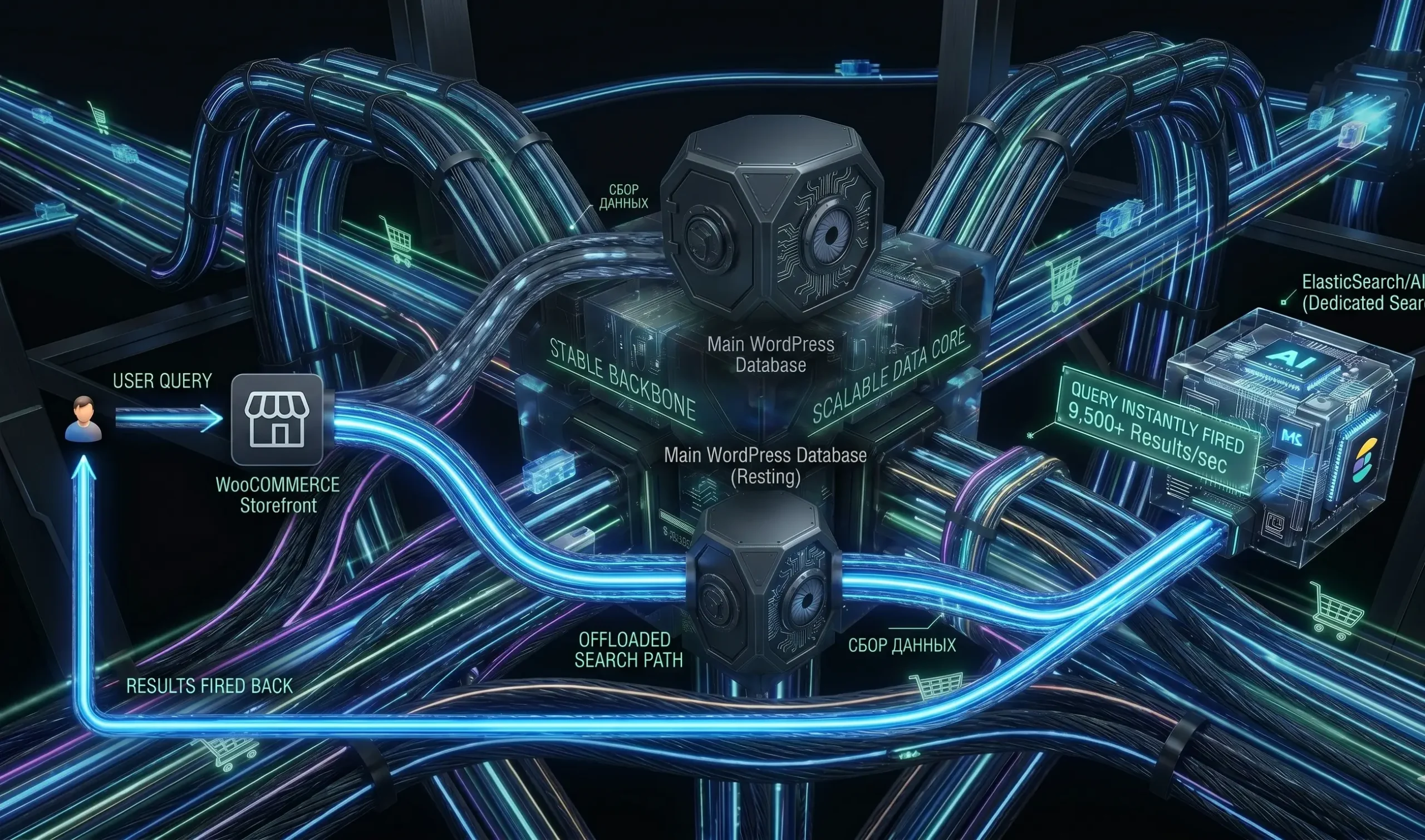
Scaling requires integrating enterprise search solutions like Elasticsearch or AI-driven vector search. These systems operate on entirely separate servers. They take the search burden completely off your WooCommerce database, delivering lightning-fast, typo-tolerant results in milliseconds while keeping your main server free to handle checkouts.
4. True Auto-Scaling Cloud Infrastructure
Traffic is rarely consistent. You might have 100 concurrent users on a Tuesday morning, and 10,000 on Friday night after an email blast. Paying for a massive dedicated server 24/7 is inefficient, but staying on a small server is risky.
The secret is a containerized, auto-scaling cloud architecture. By hosting your WooCommerce store on environments like AWS or Google Cloud via Kubernetes, your infrastructure monitors traffic in real-time. The moment traffic spikes, the system automatically spins up clone servers to handle the load. Once the traffic dies down, it scales back. You only pay for what you use, and your site never goes down.
Conclusion: Build for the Traffic You Want
Scaling to $100K+ months means transitioning your mindset from running a simple “website” to managing a robust digital application. If your WooCommerce architecture is not built to handle massive data operations efficiently, you are actively capping your own revenue potential.
Is your infrastructure holding back your sales? Don’t wait for your store to crash during your biggest campaign. Let our engineering team build a scalable, high-performance e-commerce architecture guaranteed to handle your growth.