

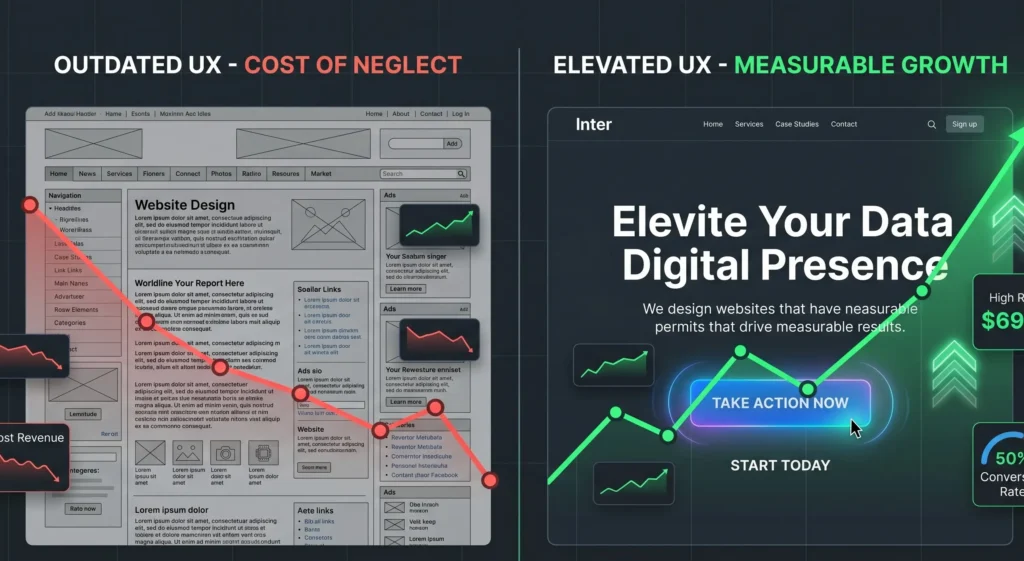
Many business leaders treat website redesigns as an aesthetic expense—something you do every five years just to keep up appearances. This is a fatal miscalculation. In 2026, User Experience (UX) is a direct revenue driver. If your website is difficult to navigate, slow to load, or visually outdated, you are not just losing clicks; you are actively sending high-paying clients to your competitors.
A strategic UI/UX refresh is not about making things “look pretty.” It is about removing friction, building immediate trust, and engineering a digital environment where users naturally convert. Here is the actual Return on Investment (ROI) of good UX and why your business cannot afford to ignore it.
1. Stopping the Revenue Leak: The Cost of Confusion
When a potential client lands on your WordPress or WooCommerce site, you have less than three seconds to answer their primary question: “Am I in the right place, and can they solve my problem?”
If your UX is cluttered, if your core services are buried under complex menus, or if your value proposition is unclear, the user will experience cognitive overload. Confusion instantly leads to a bounced session. A UX refresh fundamentally restructures your site’s architecture. By simplifying the navigation and presenting a logical, frictionless user journey, you plug the holes where your marketing budget is currently leaking, instantly increasing your retention rate.
2. Visual Authority: Selling High-Ticket Services
You cannot charge 2026 premium prices if your digital presence looks like it was built in 2015. In the B2B space and high-end e-commerce, trust is your most valuable currency. Your website is often the first interaction a client has with your brand, and users instantly judge the credibility of your business based on visual design.
A modern, highly polished UI communicates competence, stability, and authority. When your digital architecture feels premium—utilizing strategic white space, crisp typography, and seamless micro-interactions—clients unconsciously associate that premium feel with the quality of your actual services. Good UX justifies high-ticket pricing.
3. The SEO Impact: Google Ranks User Experience
A beautiful design is useless if nobody sees it. Today, search engines actively measure how users interact with your website. Google’s algorithm heavily prioritizes Core Web Vitals and user engagement metrics (like time-on-page and bounce rate).
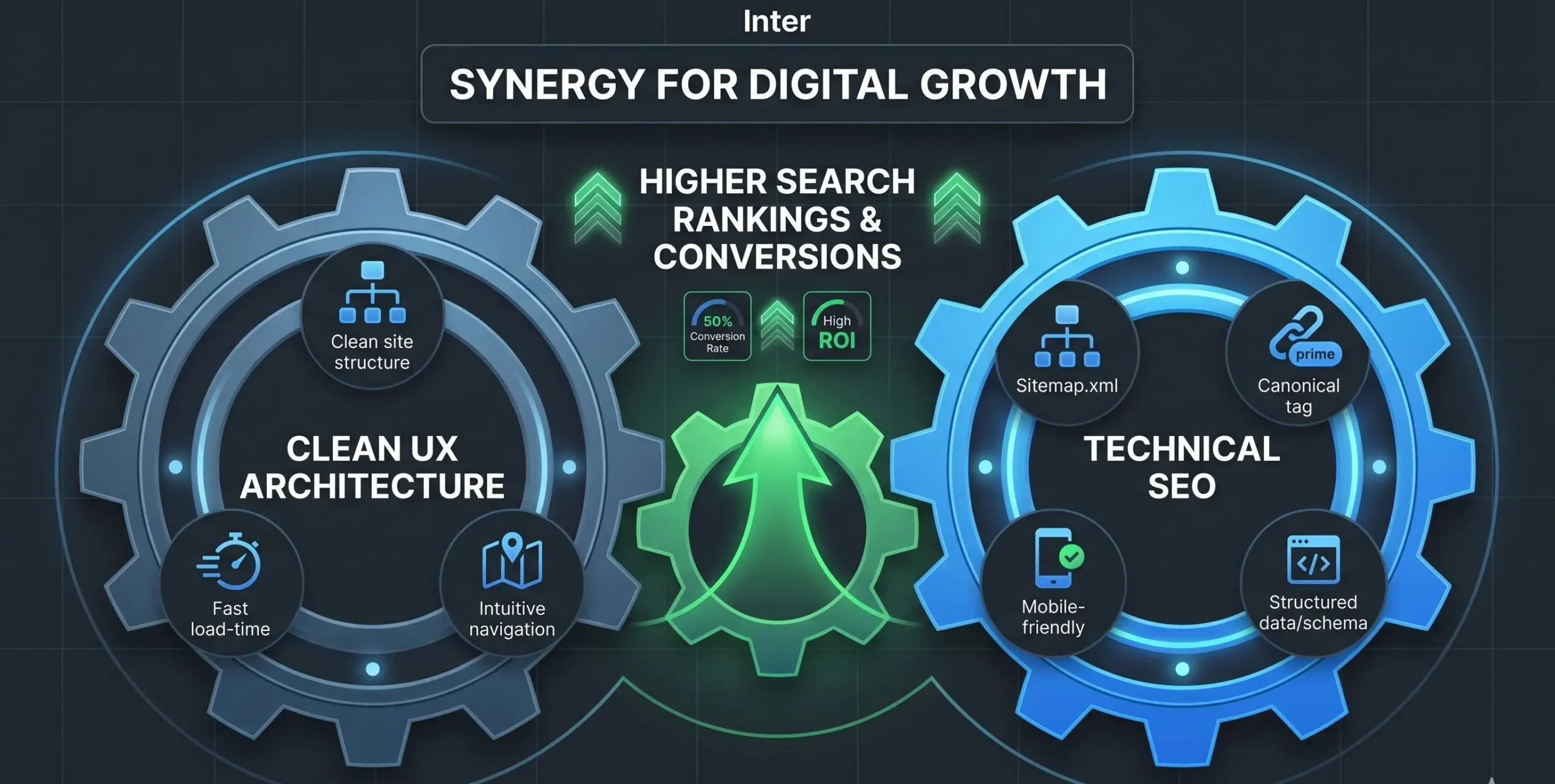
An outdated WordPress site built on heavy, bloated themes provides a poor user experience, which signals to Google that your site is low quality. A proper UX refresh strips away this bloat, integrating clean code and intuitive layouts. When users stay longer and interact more with your refined design, search engines reward you with higher organic rankings, driving more high-intent traffic to your business.
4. CRO: The Multiplier Effect on Your Marketing Budget
Think of your current website’s conversion rate. If you currently convert 1% of your 10,000 monthly visitors, you get 100 leads or sales. You could spend thousands on ads to double your traffic to 20,000, bringing you to 200 leads.
Or, you could invest in a UX refresh focused on Conversion Rate Optimization (CRO). By redesigning the checkout flow, improving form usability, and optimizing calls-to-action, you can increase your conversion rate to 2.5%. Without spending a single extra dollar on traffic, those same 10,000 visitors now generate 250 leads. Good UX does not just add to your revenue; it multiplies the effectiveness of every marketing dollar you spend.
Conclusion: Upgrade Your Digital Foundation
Ignoring UX is one of the most expensive mistakes a scaling business can make. A strategic design refresh is a direct investment into your sales pipeline, your brand equity, and your long-term growth.
Is your current website costing you clients? Let our specialized UI/UX and development team completely overhaul your digital experience, transforming your outdated site into a high-converting, modern business asset.